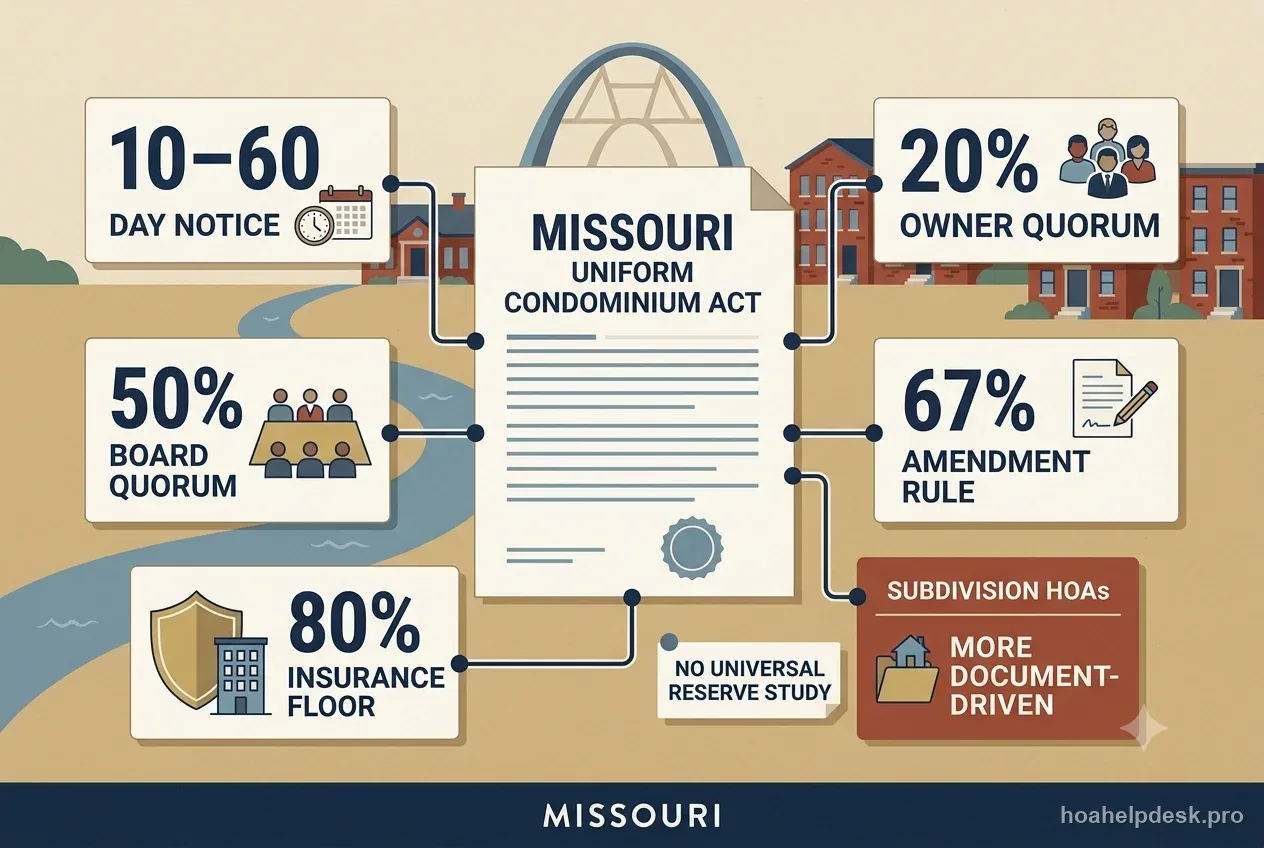
Missouri’s Uniform Condominium Act gives post-1983 condominiums concrete governance rules: owner-meeting notice is generally 10–60 days, default quorum is 20% for owner meetings and 50% for board meetings, ordinary declaration amendments generally need 67%, and required property insurance has an 80% actual-cash-value floor. The Act does not impose a recurring reserve study or general annual dues-increase cap.
Which statute governs your association
Missouri boards must distinguish a condominium from a conventional HOA and must also know the condominium’s creation date. The Uniform Condominium Act, RSMo §§ 448.1-101 through 448.4-120, applies to condominiums created after September 28, 1983. Older condominiums retain significant governance under §§ 448.005 through 448.210, while § 448.1-102 makes selected Uniform Act provisions applicable to post-1983 events without invalidating older declarations, bylaws, or plats.
Ordinary subdivision HOAs do not receive the Uniform Condominium Act merely because they collect assessments or maintain common property. Their boards should begin with the recorded declaration, bylaws, and applicable entity law. For condominiums, the declaration remains important because many statutory powers are expressly subject to it. If valid governing documents impose a stricter procedure than the statutory floor, follow them unless the statute is mandatory. Confirm the current statute text and any recent amendment before relying on this summary.
Sources: [1]
Reserve study and reserve funding
Missouri’s Uniform Condominium Act authorizes the association to adopt budgets for revenues, expenditures, and reserves, but it does not require a recurring professional reserve study or impose a universal minimum reserve-funding percentage. Section 448.3-114 addresses surplus funds after provision for common expenses and any prepayment of reserves, which shows reserves are contemplated without creating a mandatory study cycle. The declaration may impose stronger reserve obligations.
Boards should therefore distinguish statutory authority to budget reserves from a statutory duty to conduct a reserve study. A component-based funding plan can still be necessary to meet fiduciary duty and avoid destabilizing special assessments. For a conventional HOA, reserve obligations are primarily document-driven. If the declaration requires a percentage contribution, reserve account, owner vote before borrowing, or periodic study, that stricter rule should be built into the annual budget.
Sources: [1]
Insurance and fidelity bond
For condominiums covered by the Uniform Act, § 448.3-113 requires property insurance on common elements to the extent reasonably available. After deductibles, the total amount must be at least 80% of the actual cash value of the insured property at purchase and renewal, excluding land, excavations, foundations, and normally excluded items. The section also requires liability insurance at the level set by the board, but not below any amount specified in the declaration.
The Missouri statute does not create a single fidelity bond formula tied to assessments plus reserves. Boards should therefore treat property insurance, liability insurance, D&O insurance, and crime or fidelity coverage as separate decisions and check the declaration for additional requirements. If required coverage becomes unavailable, the statute contains an owner-notice rule. A conventional HOA should not cite the condominium 80% floor unless it is actually a condominium within the Act.
Sources: [5]
Open meetings, notice, and agenda
For association owner meetings under the Uniform Condominium Act, § 448.3-108 requires notice not less than 10 nor more than 60 days in advance. The notice must state the time and place and list agenda items including the general nature of proposed declaration or bylaw amendments, budget changes, and proposed removal of a director or officer. Annual meetings are required, and qualifying special meetings may be called under the statute and bylaws.
The Act does not create the same broad statutory open-board-meeting regime found in Minnesota. Board attendance rights, executive session, and advance board notice should therefore be checked against the declaration and bylaws. Do not turn the 10–60 day owner-meeting rule into a universal board-notice rule. If the governing documents promise owners broader access or longer notice, the board should honor that stricter procedure.
Sources: [2]
Quorum and voting thresholds
Missouri supplies clear default quorum rules for Uniform Act condominiums. Unless the bylaws provide otherwise, persons entitled to cast 20% of the votes that may be cast for election of the executive board must be present in person or by proxy at the beginning of an owner meeting. For a board meeting, 50% of board votes is the default quorum unless the bylaws specify a larger percentage.
Ordinary declaration amendments generally require approval of unit owners allocated at least 67% of association votes, or a larger majority in the declaration. Some fundamental changes require unanimous consent, and the older condominium regime can produce different procedures. Proxies are separately recognized by the Act. Before the board tells owners they can amend the CC&Rs with 67%, confirm the project is under the Uniform Act and that the proposed amendment is not in a special category.
Records access and retention
Uniform Act § 448.3-118 requires the association to keep financial records sufficiently detailed for statutory disclosure duties and makes financial and other records reasonably available for examination by a unit owner and authorized agents. The statute is less prescriptive than Minnesota about copy fees and less explicit than Massachusetts about a seven-year retention floor. The declaration and association policy should therefore fill procedural gaps without frustrating the statutory access right.
A sound records retention schedule should preserve the declaration, plats, amendments, minutes, and ownership-governance records permanently or for the life of the project, while setting defensible periods for financial records, contracts, insurance, elections, and collection files. Requests should be logged and handled consistently. A conventional HOA should look to its own documents and entity law because the condominium records section does not automatically govern every Missouri subdivision association.
Sources: [1]
Budget and assessment disclosure
Section 448.3-115 requires condominium assessments to be made at least annually after the association begins assessing and to be based on a budget adopted at least annually. Common expenses are generally allocated under the declaration, with special rules for limited common elements and costs benefiting fewer than all units. This statutory annual cadence gives the board a clear reason to adopt the budget formally in minutes rather than simply rolling forward the prior assessment.
Past-due common expense assessments may bear interest at the rate established by the association, but the statute caps that rate at 18% per year. That is an interest cap, not a cap on annual dues increases. Budget disclosure should separate operating expenses, reserves, insurance, and special assessments and should follow any declaration-required owner notice or vote.
Sources: [6]
Limits on assessment and fee increases
Missouri does not impose a general statewide annual percentage cap on regular condominium assessment increases. The association adopts at least an annual budget and assesses common expenses under the declaration. The 18% number in § 448.3-115 limits interest on past-due common expense assessments; it should not be misreported as an assessment-increase ceiling. Any actual dues cap or special-assessment threshold usually comes from the declaration or bylaws.
When the board needs a major increase, it should identify whether the amount is part of the regular annual budget, a reserve contribution, or a special assessment and then follow the appropriate document procedure. A conventional HOA is even more document-driven. The board should preserve the adopted budget, allocation calculation, notices, and vote record before referring a delinquent assessment to collections.
Sources: [6]
Fines and enforcement due process
Missouri’s Uniform Condominium Act expressly authorizes reasonable fines only after notice and an opportunity to be heard. Section 448.3-102 also authorizes late charges and D&O insurance, while § 448.3-116 makes qualifying fines and charges enforceable through the association lien structure under defined conditions. The notice-and-hearing requirement should therefore be completed before the board treats a violation fine as final.
A good enforcement file identifies the violated declaration, bylaw, or rule; provides the owner with the promised hearing; records the board’s determination; and separates the fine from unpaid regular assessments and collection charges. Older condominiums and conventional HOAs can have different authority, so the board should trace the remedy to the applicable statute and documents instead of assuming the Uniform Act procedure applies everywhere.
Sources: [1]
Sources
- Missouri Revised Statutes, Chapter 448 — Uniform Condominium Act rangeOfficial Revisor chapter range; primary source and applicability context.
- RSMo § 448.3-108 — MeetingsOfficial 10–60 day owner-meeting notice rule.
- RSMo § 448.3-109 — QuorumsOfficial 20% owner and 50% board default quorum rules.
- RSMo § 448.2-117 — Amendment of declarationOfficial 67% ordinary declaration-amendment rule and unanimous-consent exceptions.
- RSMo § 448.3-113 — InsuranceOfficial condominium property/liability insurance requirements and 80% actual-cash-value floor.
- RSMo § 448.3-115 — Assessments for common expensesOfficial annual budget/assessment rule and 18% maximum interest on past-due common expenses.
Compare nearby state rules
Check one decision against the statute
For a single board decision — a fine, a special assessment, a records request, an election, a CC&R amendment — the State Decision Lookup resolves the verified statutory rule for Missouri and a growing set of other states, and the Board Decision Router lays out the research sequence. Both fail closed when the primary law is unclear rather than guessing.