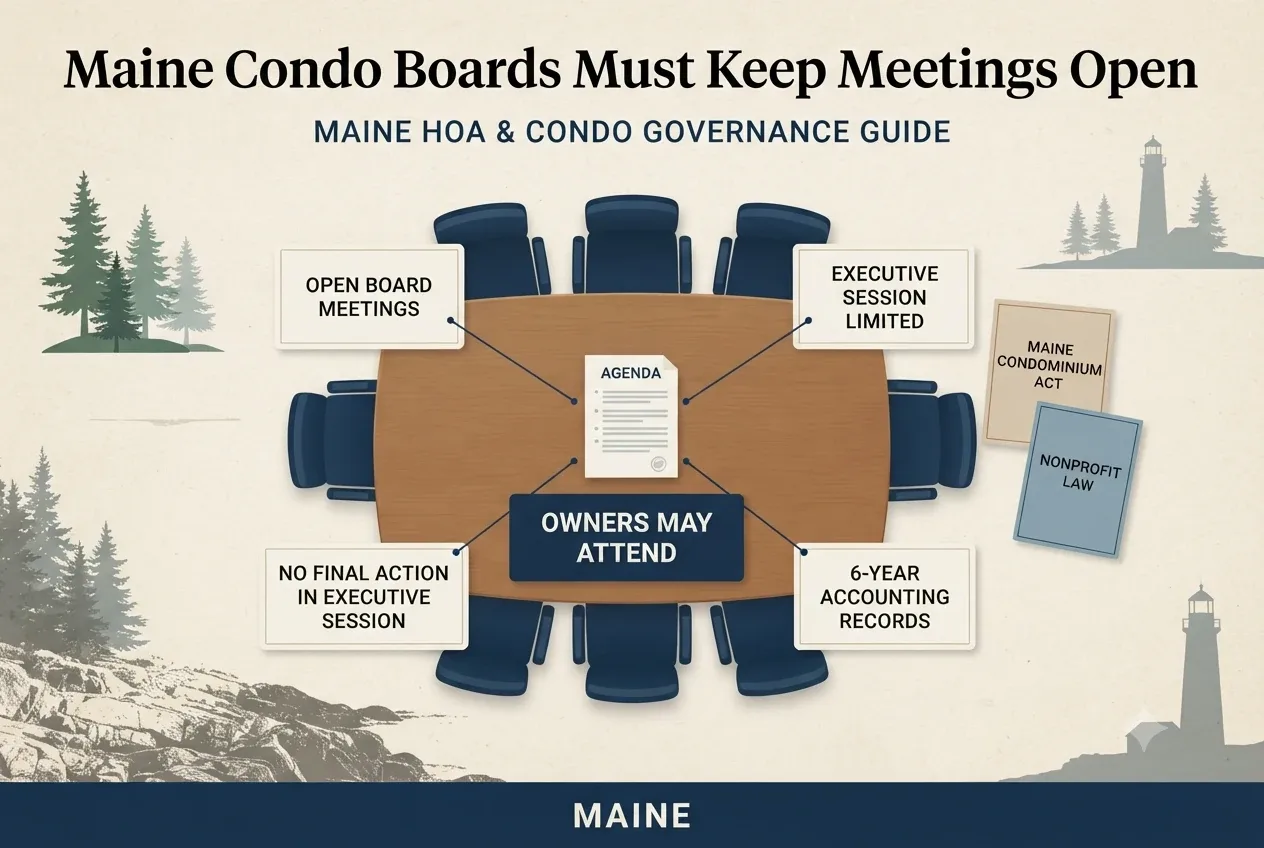
Maine has a detailed Condominium Act but no single comprehensive HOA act. Condo owner meetings generally use 10–60 day notice, condo accounting records are kept for six years, and the master policy has an 80% actual-cash-value statutory floor where applicable. Maine does not impose a general reserve-study cycle or statewide annual-dues cap for every association.
Which statute governs your association
Maine has a comprehensive Condominium Act but no equivalent single statewide HOA act for every planned subdivision. Condominiums are governed by 33 M.R.S. chapter 31. A non-condominium HOA is primarily governed by its recorded declaration and bylaws, together with generally applicable real-property law and, when incorporated as a nonprofit, the Maine Nonprofit Corporation Act in Title 13-B.
The Maine Condominium Act became effective January 1, 1983. Condominiums created before that date may remain subject to the earlier statutory regime and their instruments, although §1601-102 applies selected provisions to older condominiums for later events and allows older projects to amend into the modern Act. A board should confirm the project’s creation date before treating a modern section as the full answer. If the declaration, CC&Rs, or bylaws impose a stricter procedural requirement than the statute, the board should follow the governing documents unless the statutory provision is mandatory and does not permit variation. Confirm the current statute text and any recent amendment before relying on this summary.
Reserve study and reserve funding
Maine does not impose a general statewide reserve study cycle on HOAs, and the Condominium Act does not require every condominium to commission a recurring engineering reserve study. The condominium disclosure and budget framework nevertheless expects boards to identify whether money is included as a reserve for repairs and replacement and to state the amount and purpose of other reserves in the project’s financial materials.
For a non-condominium HOA, reserve obligations usually come from the declaration, bylaws, adopted budget, contracts, and the board’s general fiduciary standards rather than a specific state reserve-study statute. For condos, the absence of a mandatory cycle should not be confused with permission to ignore foreseeable capital obligations. Boards should document replacement assumptions and explain how reserve contributions relate to known common-element responsibilities.
Insurance and fidelity bond
The Maine Condominium Act requires the association, to the extent reasonably available, to maintain property insurance on common elements against commonly insured risks. The amount after deductibles must be at least 80% of the actual cash value of the insured property, excluding land, excavations, foundations, and other normally excluded items. The association must also carry liability insurance in an amount set by the executive board but not below any declaration requirement.
Maine does not impose the same statewide fidelity-bond formula on every HOA and condominium that some states do. A condo board should inspect the declaration and management contracts for any crime or fidelity requirement, and a nonprofit HOA should assess crime coverage as part of treasury controls even if no project-specific statute states a numeric minimum. D&O insurance remains a separate board-risk decision from the master property policy.
Open meetings, notice, and agenda
A Maine condominium association must meet at least once each year. The bylaws designate the officer who gives notice, and notice must be sent not less than 10 and not more than 60 days before the meeting. It must state the time, place, and agenda items, including the general nature of proposed declaration or bylaw amendments, budget changes, and any proposal to remove a director or officer.
Condominium executive-board meetings are more open than many summaries suggest. The board must give timely notice reasonably calculated to inform unit owners of the date, time, place, and proposed topics, and unit owners have a statutory right to attend subject to reasonable board rules. Executive sessions are limited to listed subjects such as legal advice, litigation, personnel, negotiations, and privacy, and no final vote or action may occur there. For a non-condominium HOA, board-meeting procedure depends more heavily on Title 13-B and the bylaws.
Quorum and voting thresholds
Maine condominium quorum, proxy, and voting rules are found in the Condominium Act and the declaration, while an incorporated HOA also needs to consider the Nonprofit Corporation Act and its bylaws. The statute does not create one universal owner quorum or CC&R-amendment percentage that can safely be quoted for every HOA and condominium. Boards should retrieve the recorded declaration before announcing the vote needed for an amendment.
The practical distinction is between attendance requirements and approval requirements. A meeting can have a valid quorum yet still lack the supermajority needed to amend a declaration, terminate a condominium, sell common property, or take another protected action. Proxy use should likewise be checked against the applicable statute and bylaws. A board should record both the quorum calculation and the separate approval calculation in the minutes.
Records access and retention
The Maine Condominium Act has a detailed retention rule. Accounting records affecting operation and administration must be kept for the past six years. The association also retains owner and executive-board minutes other than executive-session minutes, action without meetings, owner lists, organizational documents, current rules, contracts, ballots and proxies for the prescribed periods, and other records listed in §1603-118.
For incorporated HOAs, the Maine Nonprofit Corporation Act separately requires correct and complete books and records, minutes, and a voting-member list. A voting member with a proper purpose may inspect corporate books and records at a reasonable time after at least five business days’ written notice. Because condo and nonprofit statutes overlap differently depending on entity form, the records policy should identify which law supports each retention and inspection rule.
Budget and assessment disclosure
Maine condominium law places budget information at the center of association financial disclosure. The board should identify operating expenses, common-expense assessments, and reserve assumptions rather than presenting only a bottom-line dues number. The declaration and bylaws determine how the budget is adopted and how assessments are allocated among units, subject to mandatory provisions of the Condominium Act.
For a non-condominium HOA, there is no single Title 33 planned-community budget statute comparable to Louisiana’s new ratification procedure. The board’s authority instead comes from the declaration, bylaws, nonprofit-corporation powers, and any recorded assessment covenant. Annual budget notice, owner approval, and special-assessment procedure therefore need to be mapped from those documents rather than copied from the condominium statute.
Limits on assessment and fee increases
Maine does not impose a general statewide percentage cap on annual dues increases for every HOA or condominium. A declaration may contain its own ceiling, formula, or owner-vote trigger, and a condominium’s common-expense allocations may be protected by recorded ownership interests that the board cannot simply rewrite through an annual budget. Boards should therefore avoid publishing a generic Maine fee cap.
When an assessment increase is needed, the board should identify the legal source of authority, the purpose of the increase, and whether it is regular, special, or tied to a capital project. If the governing documents require membership approval, that requirement controls the process. If the declaration, CC&Rs, or bylaws impose a stricter procedural requirement than the statute, the board should follow the governing documents unless the statutory provision is mandatory and does not permit variation.
Fines and enforcement due process
Maine does not supply one statewide fine schedule for all associations. Condominium enforcement authority must be traced through the Condominium Act, declaration, bylaws, and rules, while a non-condominium HOA depends even more heavily on the recorded covenants. Before imposing a fine, the board should verify that the governing documents actually authorize monetary sanctions and should follow any notice and hearing process they prescribe.
Boards should also distinguish a fine from a common-expense assessment. The fact that an association has lien authority for unpaid assessments does not automatically answer whether a covenant-violation fine may be added to that lien. A defensible file should show the rule violated, notice, opportunity to respond, board decision, amount, and the source of authority. Confirm the current statute text and any recent amendment before relying on this summary.
Sources
- Maine Condominium Act, 33 M.R.S. ch. 31Official Maine Legislature chapter index for the Condominium Act.
- 33 M.R.S. §1601-102 — condominium applicabilityOfficial applicability and pre-1983 condominium transition provisions.
- 33 M.R.S. §1603-108 — condominium meetingsOfficial annual-meeting and 10–60 day notice rule.
- 33 M.R.S. §1603-118 — condominium recordsOfficial records retention and owner-access requirements.
- 33 M.R.S. §1603-113 — condominium insuranceOfficial master-property and liability insurance requirements.
- Maine Nonprofit Corporation Act, 13-B M.R.S. §§602–715Official nonprofit-corporation law relevant to incorporated HOAs, including meetings, director procedure, and records.
Compare nearby state rules
Check one decision against the statute
For a single board decision — a fine, a special assessment, a records request, an election, a CC&R amendment — the State Decision Lookup resolves the verified statutory rule for Maine and a growing set of other states, and the Board Decision Router lays out the research sequence. Both fail closed when the primary law is unclear rather than guessing.