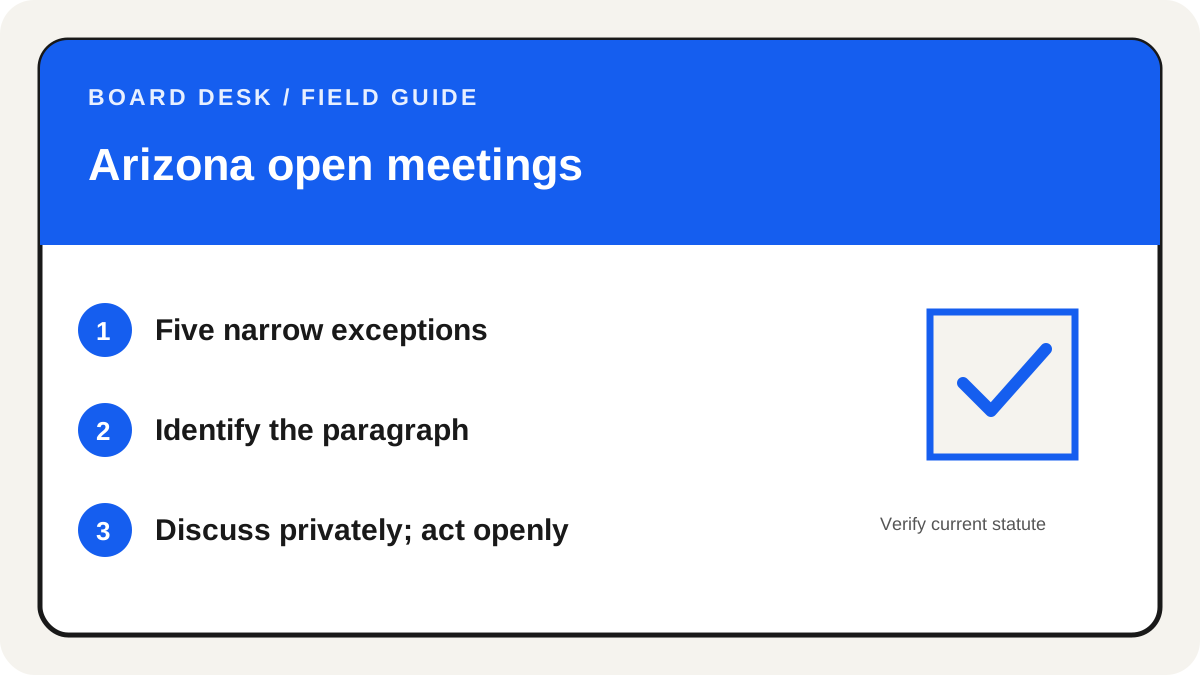
Arizona’s 2026 amendment makes the exception concrete: an HOA board may close only a portion of a meeting for one or more listed subjects, and may discuss those subjects without taking action. The board must also identify the statutory paragraph that permits the closed portion.
What changed in 2026
Senate Bill 1290 amended Arizona Revised Statutes § 33-1804, the planned-community open-meeting provision. The amended law states that association-member meetings, board meetings, and regularly scheduled committee meetings are open to members or a member’s written designee. It then permits a portion of a meeting to be closed only when that portion is limited to consideration without action of one or more enumerated subjects. It also requires the board, before entering a closed portion or in the meeting notice if closure is planned, to identify the paragraph in subsection A that authorizes it.
The amendment became Chapter 222 and was approved June 22, 2026. The effective-date summary lists September 12, 2026. A.R.S. § 33-1804 still contains other procedures, including advance notice after declarant control, agendas, member speaking opportunities, and recording rules. This article concentrates on the new closed-session boundary; for broader agenda and notice principles see our open-meeting notice and agenda guide and Arizona’s Arizona law overview.
Match the subject to one of five paragraphs
- Legal advice: advice from an attorney for the board or association. The statute addresses later disclosure after final resolution, subject to confidentiality required by a settlement or judgment.
- Pending or contemplated litigation: a matter that is actually pending or contemplated, not simply a disagreement the board would rather not discuss publicly.
- Sensitive individual information: personal, health, or financial information about an individual member, association employee, or contractor employee, including directly related association records.
- Specific employee matters: job performance, compensation, health records, or specific complaints about an individual employee of the association or an association contractor working under its direction.
- A member’s appeal: discussion of an individual member’s appeal of a cited violation or imposed penalty, unless the affected member requests an open meeting.
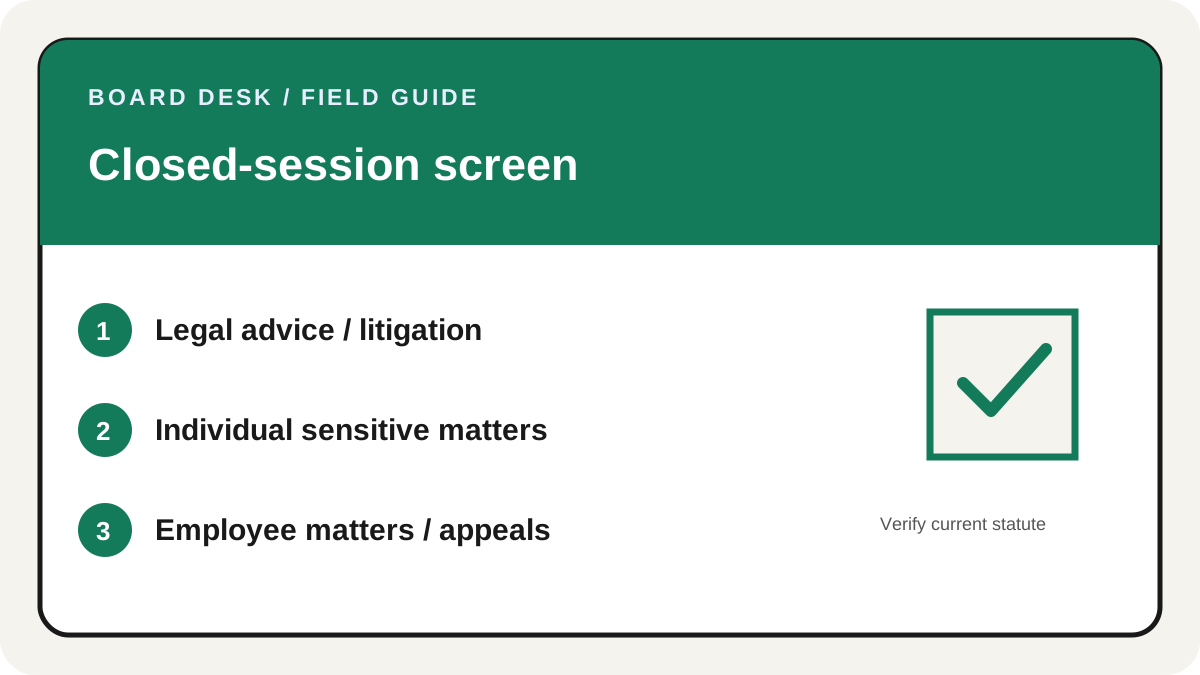
These categories are not interchangeable labels. A general policy debate about enforcement is different from deliberating a specific member’s appeal. A contract question is not automatically personnel information because a vendor is involved. A board should be able to state, in plain terms, which statutory paragraph applies to the particular discussion and why the facts fit it.
Apply the “consideration without action” limit
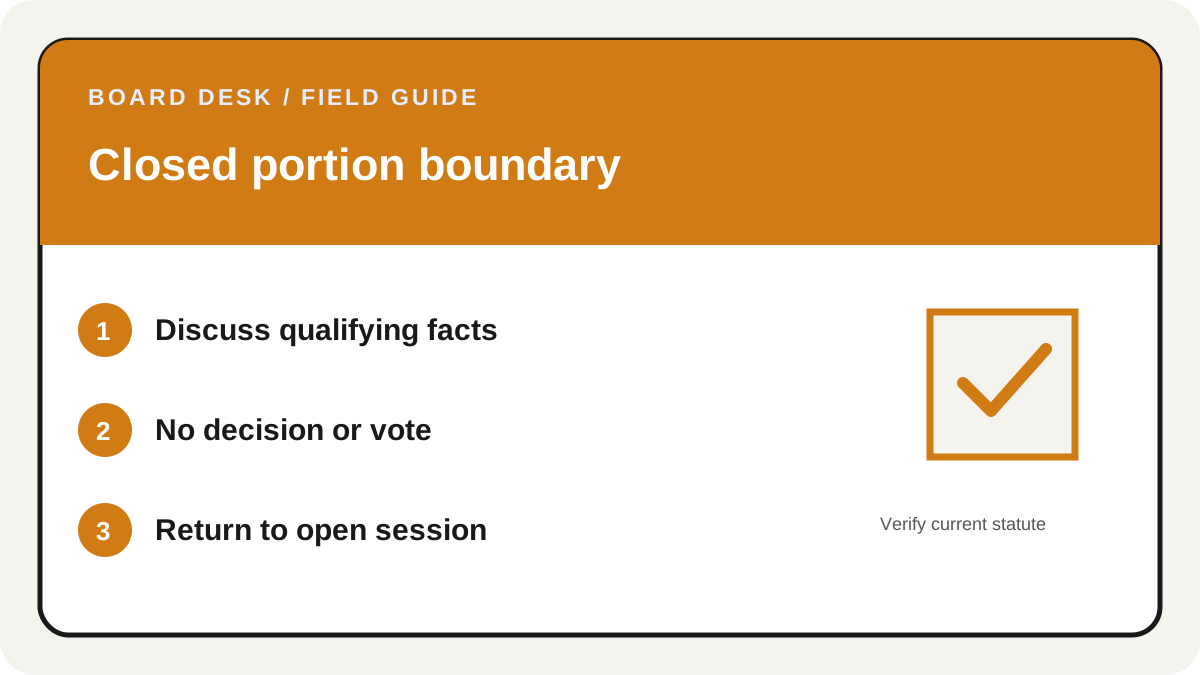
The closed portion is for consideration without action. Use it to receive protected advice, discuss the listed private subject, and identify what the board needs to do next. Do not treat it as a place to approve a contract, impose a fine, resolve an appeal, authorize a payment, direct a final decision, or take another board action simply because the underlying topic qualifies for closed discussion.
When the board is ready to decide, return to the open meeting and place the matter before the board in a way owners can understand. The statute’s open-meeting framework provides a member opportunity to speak after the board has discussed a specific agenda item and before formal action, subject to reasonable time limits. The public portion need not reveal confidential legal advice or protected personal details; the board can describe the action at an appropriate level while keeping protected specifics confidential.
For an individual enforcement appeal, the member’s express request matters: the law says the appeal discussion exception does not apply when the affected member asks for an open session. Record the request and ensure the agenda and logistics reflect it. Do not assume that the board can override the member’s preference simply because the file includes sensitive information; if the facts create a conflict between exceptions, ask counsel how to handle that particular meeting.
Identify the exception before owners arrive
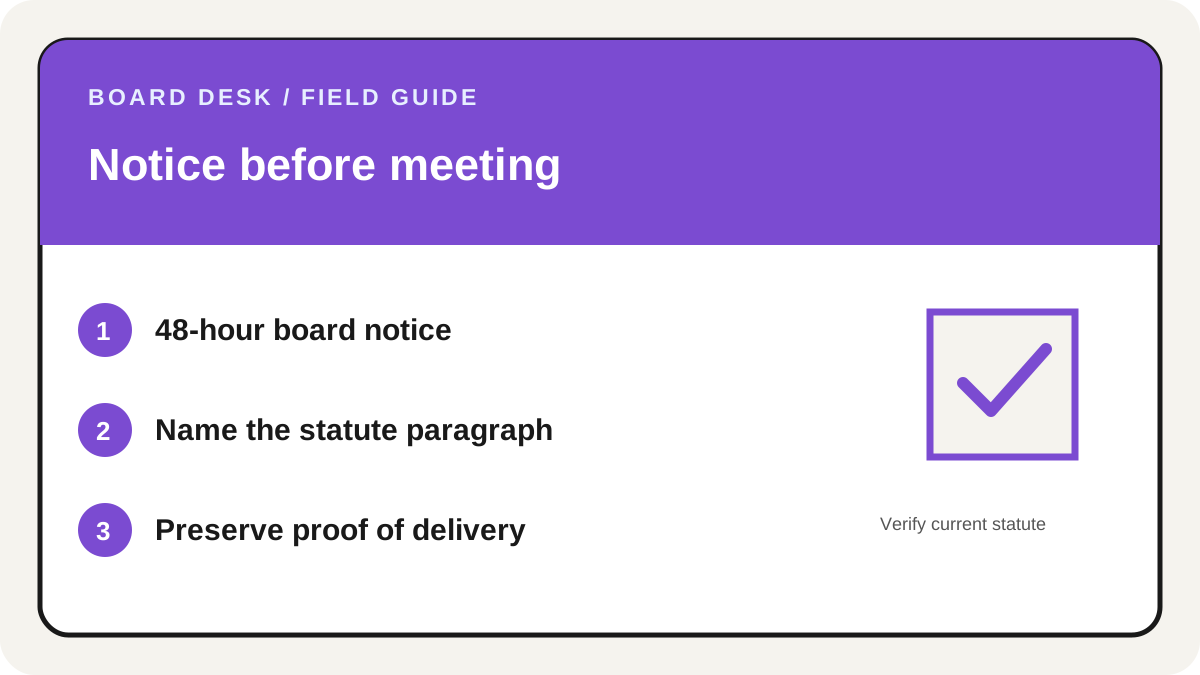
If a closed portion is planned, add the statutory paragraph to the meeting notice. If the need arises during an open meeting, the board must identify the paragraph before entering the closed portion. A useful statement is specific but restrained: “The board will enter a closed portion under A.R.S. § 33-1804(A)(2) to discuss pending litigation.” For a sensitive individual matter, use the correct paragraph and avoid naming private information in a public notice.
After declarant control ends, board meeting notice and agendas generally must be given at least 48 hours in advance through a newsletter, conspicuous posting, or another reasonable method selected by the board. The board should check whether its governing documents require more notice or additional channels. A notice affidavit from a corporate officer is prima facie evidence that notice was given as prescribed, so retain the dated notice, posting proof, distribution record, and agenda version that owners actually received.
Do not confuse the board-meeting deadline with member-meeting notice. Section 33-1804 uses a different 10-to-50-day window for notice of a member meeting. Nor should a board use the emergency-meeting provision as a routine shortcut: emergency meetings are limited to business that cannot wait for the 48-hour period, and the minutes must state why the emergency meeting was necessary and be read and approved at the next regular board meeting.
Keep an accurate record without publishing confidential details
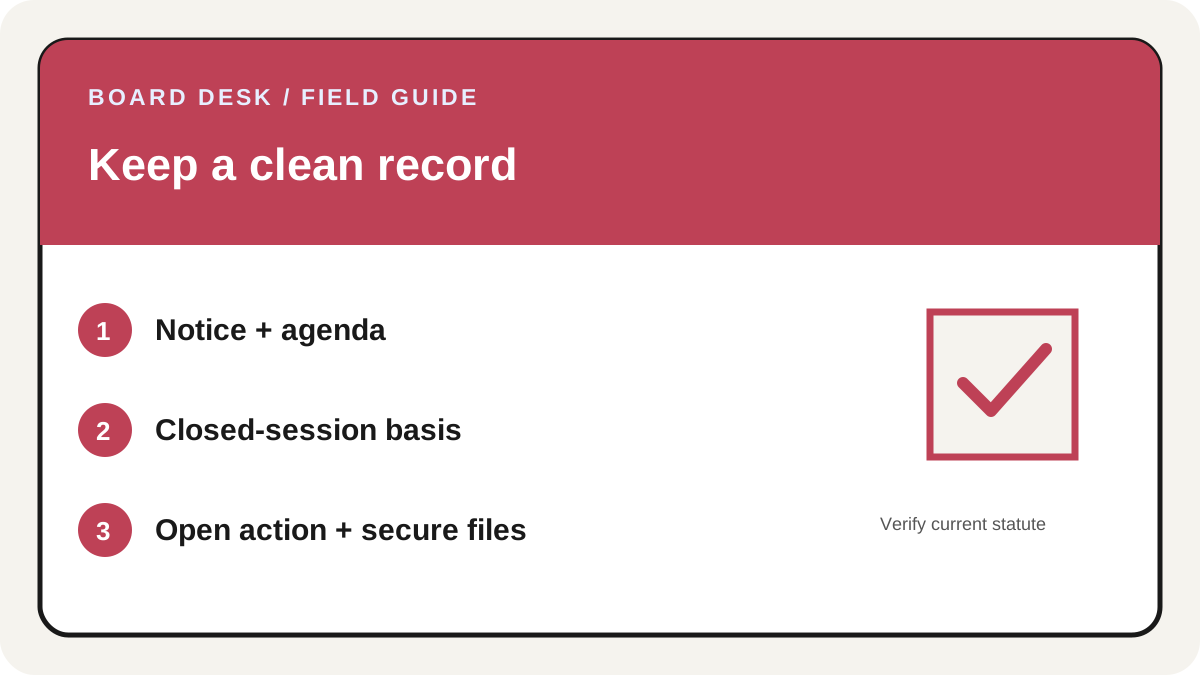
Prepare an agenda that identifies the expected closed portion and paragraph. In the open record, capture the motion or announcement to enter closed session and the statutory basis stated by the board. Keep the minutes factual: meeting date, attendees, time closed and reopened, paragraph cited, and any procedural action taken in open session. Do not make the public minutes a transcript of privileged legal advice or disclose individual health, financial, or employment information that the statute allows the board to consider privately.
At the same time, “closed” should not mean “unrecorded in every sense.” Keep the association’s internal record securely with access limited under applicable law and policy. If the board records open portions, § 33-1804 requires it to keep a copy for at least six months and make the unedited recording available to a member on request in compliance with § 33-1805(A). The statute separately permits attendees to record open portions under its stated conditions. Confirm the current records-access law before responding to a request that concerns a closed-session record.
Run a repeatable meeting workflow
- Screen the topic: write down the actual question and the facts needed to classify it.
- Choose one or more paragraphs: confirm the facts fit the statutory text; if not, keep the discussion open.
- Notice it correctly: include the paragraph when a closed portion is planned and meet the applicable notice window.
- Open the meeting: state the statutory basis before closing; allow the ordinary open-meeting process for other agenda items.
- Limit the closed discussion: address only the qualifying subject and take no action.
- Reopen and decide openly: make any board decision in the open portion and allow the required owner comment opportunity before formal action.
- Preserve records: keep notice proof, the agenda, minutes, any open-meeting recording, and protected records in their appropriate locations.
Common mistakes to avoid
Do not close the entire meeting when only one segment qualifies. Do not use a generic “confidential matters” label without identifying the statutory paragraph. Do not discuss a broad vendor dispute in closed session unless the actual subject fits a listed exception. Do not make the decision privately and announce only the result afterward. And do not assume the member appeal exception survives an affected member’s request for an open session.
If a board is uncertain whether a topic fits an exception, the safer operational choice is to keep discussion open while seeking legal guidance, or postpone the matter until the board can give proper notice. Governing documents can add procedural requirements but do not turn the statutory list into an unlimited discretion to close meetings. This is general information, not legal advice; check the current statute, association type, declaration, bylaws, and facts with Arizona counsel before relying on it.
Primary sources checked
- Arizona Legislature, SB 1290, Chapter 222, amending A.R.S. § 33-1804.
- Arizona House Committee on Commerce, 2026 session laws summary (effective date: September 12, 2026).
Frequently asked questions
- What subjects can an Arizona planned-community HOA discuss in closed session?
- A.R.S. § 33-1804(A) lists legal advice, pending or contemplated litigation, specified individual personal/health/financial information, defined employee matters, and a member’s violation or penalty appeal unless that member requests an open session.
- Can the board vote or approve something in the closed portion?
- No. The statute permits only consideration without action in the closed portion. Any board decision should be made after returning to the open meeting, following the applicable agenda and owner-comment process.
- How does the board identify the reason for closing a meeting?
- If planned, identify the authorizing paragraph in the meeting notice. If the need arises during an open meeting, identify the paragraph before entering the closed portion.
- How much notice is required for Arizona HOA board meetings?
- After declarant control ends, board meeting notice and agendas generally must be given at least 48 hours in advance by a newsletter, conspicuous posting, or another reasonable method determined by the board. Governing documents may impose additional procedures.
- Does SB 1290 apply to Arizona condominium associations?
- This guide addresses planned communities under § 33-1804. Condominiums have a separate open-meeting statute, § 33-1248; verify that statute’s current text and effective amendments before applying this guide to a condominium.
These answers describe the general research path. The controlling rule for your association comes from your state statute and recorded governing documents — verify the current primary source and its effective date before the board acts.