Colorado’s HB 26-1099 creates several connected handoff duties, but they do not all apply to every HOA or run on the same clock. Boards should distinguish the declarant’s study for a new community from the association’s owner disclosure and from a later management-company change.
What HB 26-1099 changed
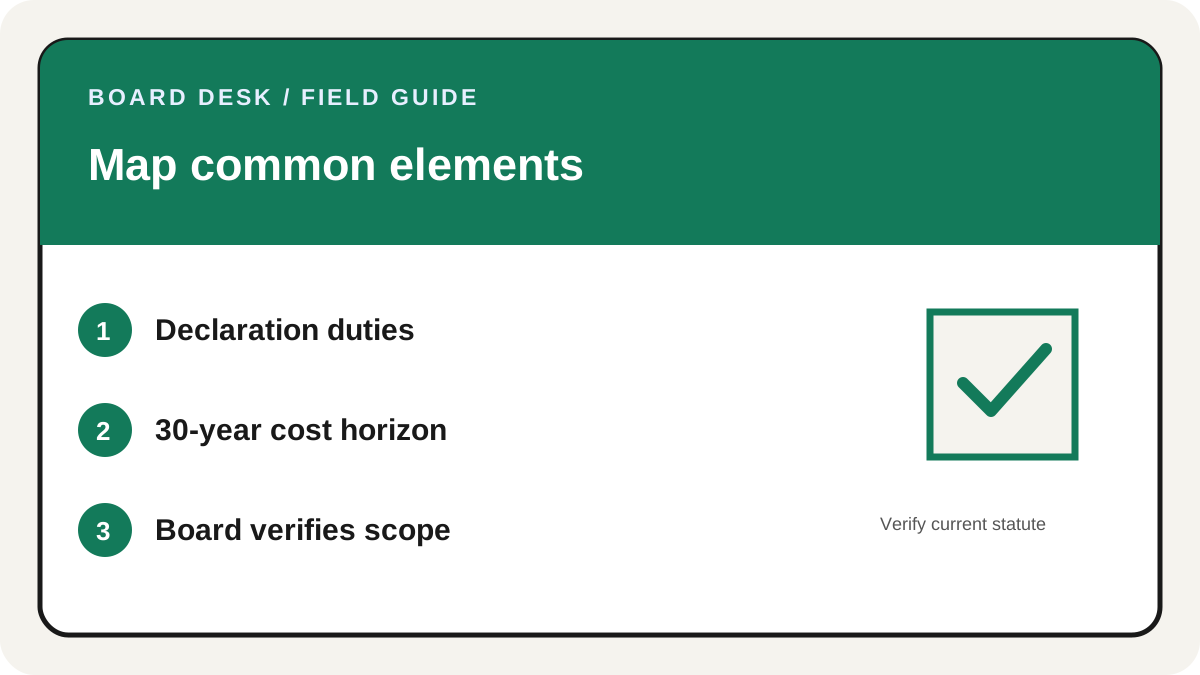
Colorado enacted House Bill 26-1099 as Chapter 42. Its new C.R.S. § 38-33.3-209.2 places the commissioning and payment duty on the declarant before control transfers to the association for a planned community or condominium. The study must cover common elements and property that the association is responsible for maintaining, repairing, or replacing under the declaration, and project costs over a 30-year period. This focuses the study on the association’s actual responsibilities, rather than every feature somewhere inside the development.
The law makes the declarant responsible for procuring and paying for the study; it does not say a new owner board should treat the document as a warranty, a guaranteed budget, or a substitute for its own review. A new board still needs to understand assumptions, component condition, useful-life estimates, cost basis, funding method, and what was excluded. The study is a planning baseline that should be tested against the property and the governing documents.
Confirm whether your community is in scope
Start with the declaration and recorded plats, then confirm whether the legal form is a planned community or condominium under Colorado’s Common Interest Ownership Act. Identify who maintains each roof, road, private utility, pool, retaining wall, elevator, and other common component. A component may be physically located within the development but outside the association’s maintenance duty; the statute ties the study to association responsibility as described in the declaration.
Next, determine whether declarant control has transferred and when the owner-elected majority took office. Preserve the election minutes, turnover notice, and control-transfer date. Those facts anchor the existing 60-day transfer of association property and the separate 90-day disclosure clock. If there were phased turnovers or disputes about the control date, ask Colorado association counsel to identify the legally operative event instead of choosing the date that is easiest for the calendar.
Review the study’s scope and assumptions
Compare the study’s asset list with the declaration, maintenance matrix, current insurance schedule, and actual site inspection. Flag a common element that is missing, assigned to the wrong party, or described at a level that makes future costs hard to budget. For every included component, ask whether the report explains quantity, condition, estimated remaining life, projected repair or replacement cost, inflation assumptions, and the timing behind that projection.
The 30-year projection horizon is a requirement of the new statutory study, not a promise that every cost forecast will be accurate for three decades. Ask the professional to state the price date and assumptions, and to explain whether taxes, permitting, engineering, mobilization, or inflation are included. Keep the raw report and any executive summary together; a short summary alone may omit the component detail the board needs to build its budget.
Turn the findings into a list of decisions rather than simply filing the PDF. Identify components with near-term work, compare the study’s suggested contribution path with actual reserve balances, and determine whether the board needs bids, a site inspection, or a separate engineering opinion. If the study’s funding model differs from the adopted budget, record the reason for the board’s chosen path and any owner communication needed.
Check professional independence before accepting the report
The statute requires an independent reserve-study professional or another qualified professional who knows industry standards, has no business relationship or financial interest in the declarant other than being retained to conduct reserve studies, and is not the declarant’s affiliate. Ask the declarant for the professional’s qualifications and written independence disclosure. Save the engagement scope, report date, author credentials, and any clarification letters with the transition records.
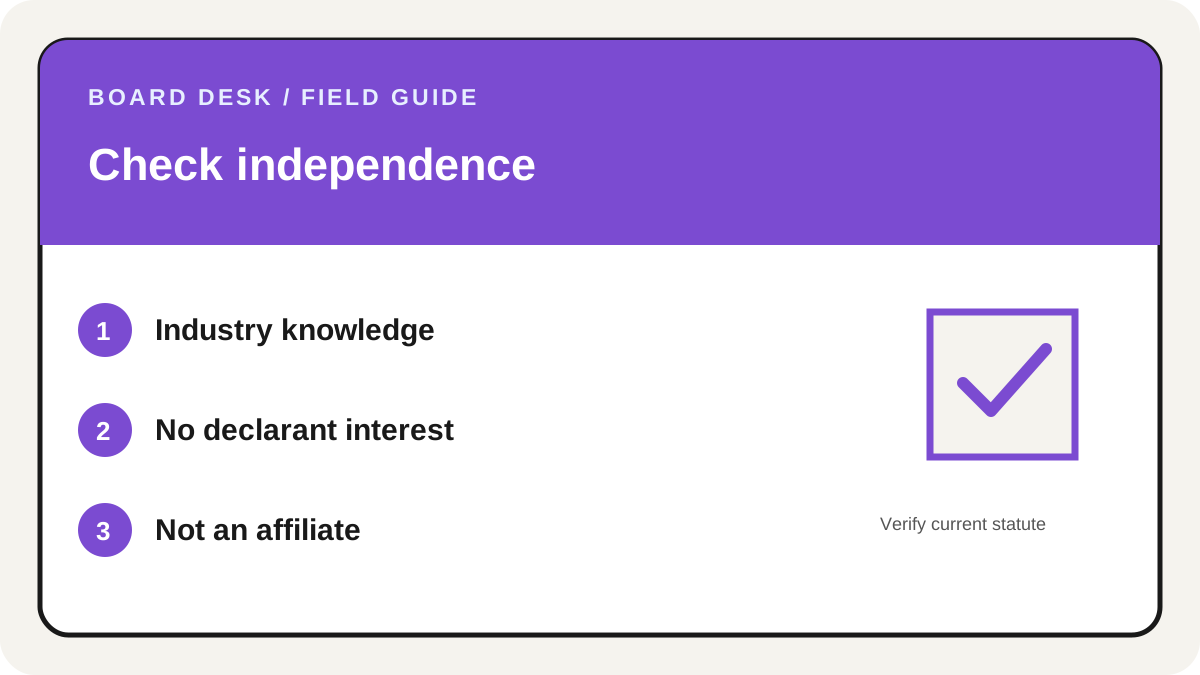
Independence does not mean that the professional must be selected or paid by the incoming board; the law assigns commissioning and payment to the declarant. It does mean the board should not assume that an affiliated developer consultant meets the statutory test just because the report is polished. If the relationship is unclear, request clarification before relying on the study, and have counsel assess the statutory language rather than making a conclusory accusation.
Use the 60-day and 90-day periods for different work
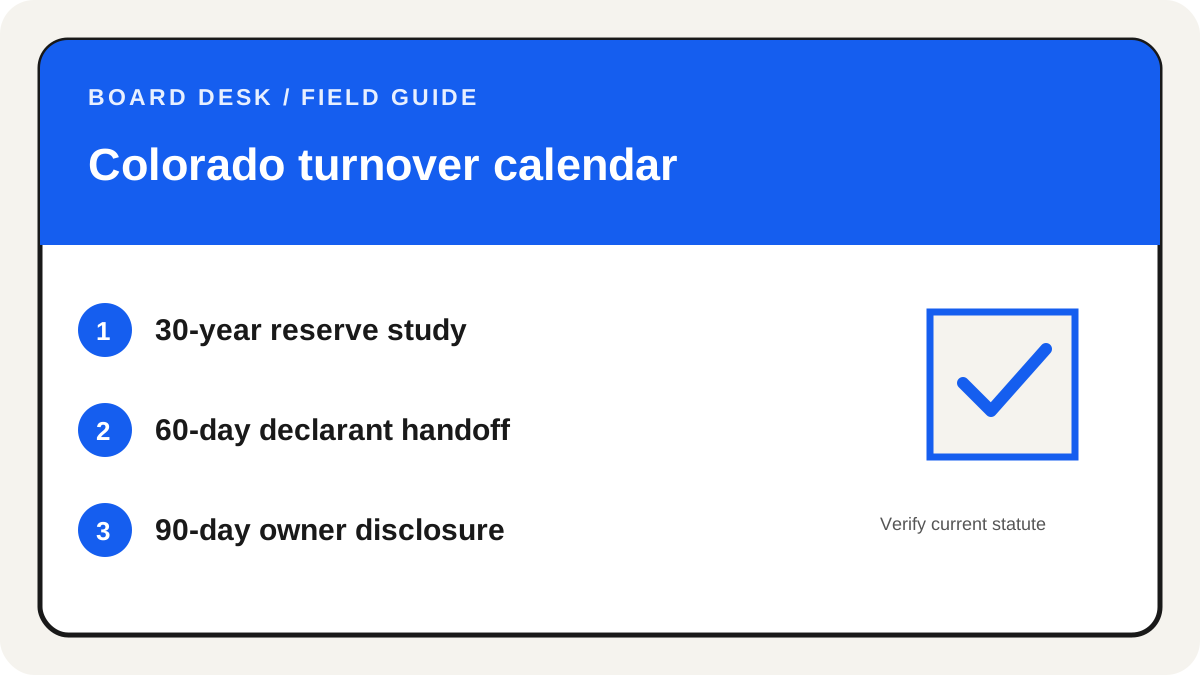
Colorado’s existing transition provision, C.R.S. § 38-33.3-303(9), requires the declarant to deliver association property within 60 days after non-declarant unit owners elect a majority of the executive board. HB 26-1099 adds the commissioned reserve study to the listed handoff items. Create a written receipt checklist for the transition package and note missing items immediately; do not wait until the end of the separate annual disclosure cycle to ask where the study went.
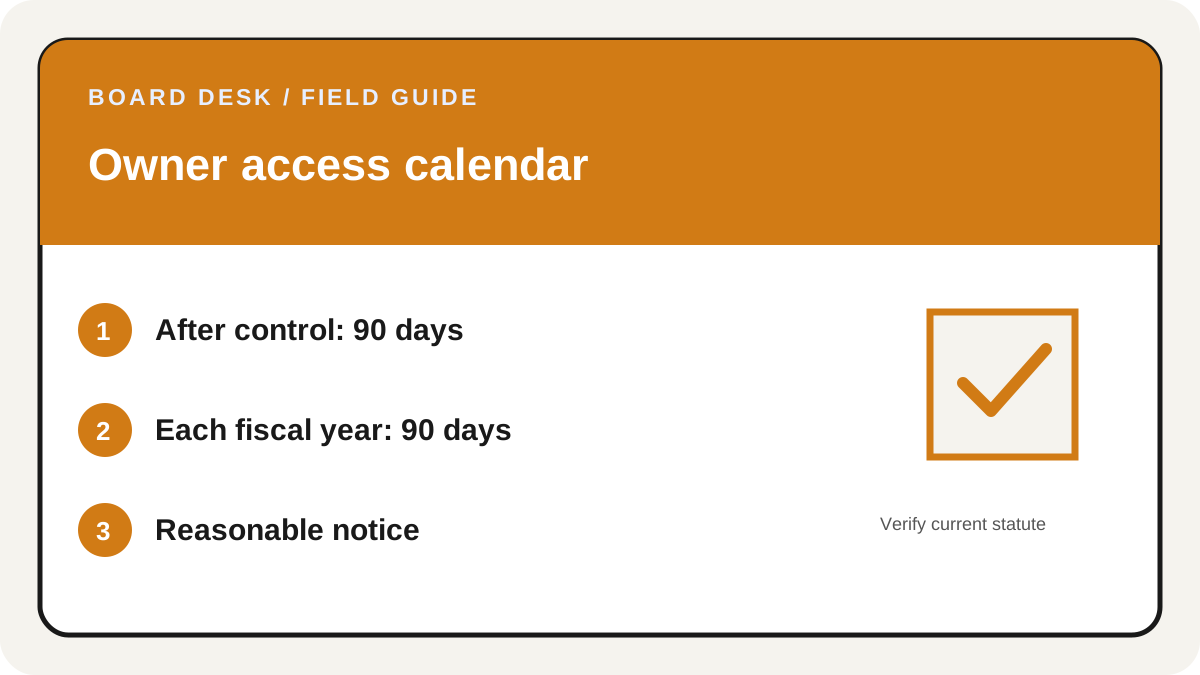
A different rule concerns owner access. Under amended § 38-33.3-209.4, within 90 days after assuming control from the declarant and within 90 days after each fiscal-year end thereafter, the association must make its most recent required reserve study available to unit owners upon reasonable notice. Record the fiscal-year end date, the responsible person, where the document is kept, and the request method. This is an availability obligation; it is not worded as an automatic mailing of the full study to every owner.
Do not confuse declarant turnover with changing managers
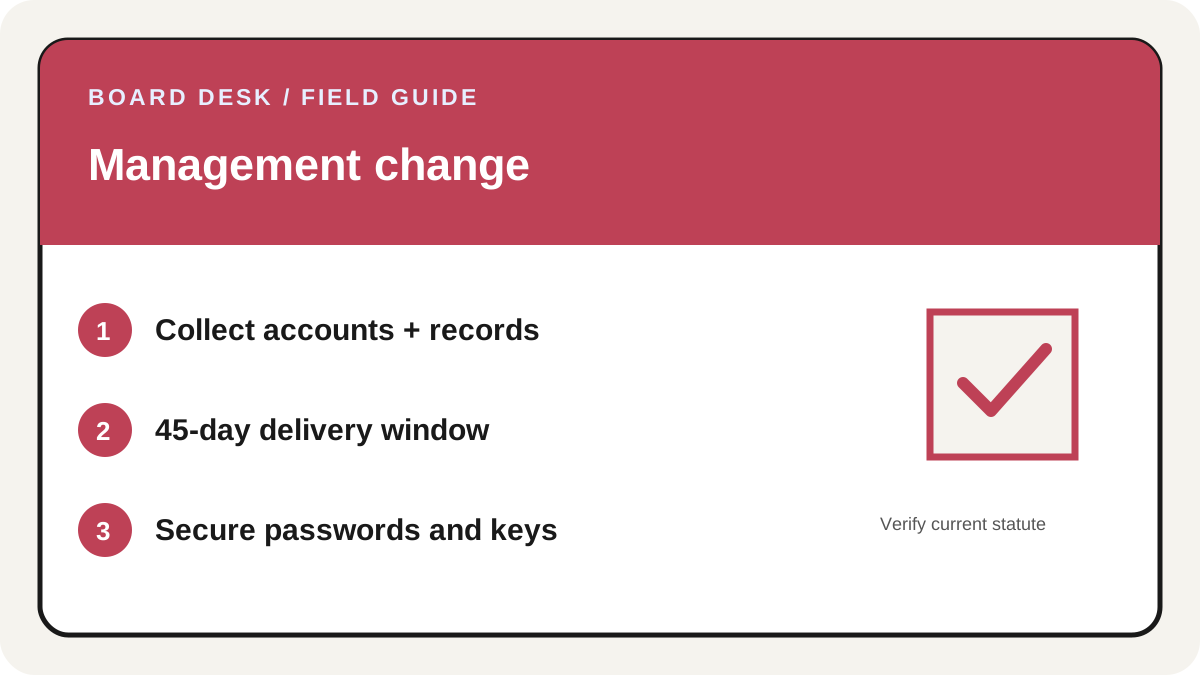
HB 26-1099 also adds a separate 45-day transfer rule in C.R.S. § 38-33.3-317(9). It applies when an association that has an association management company terminates or does not renew its agreement; it excludes a self-managed association that has not retained a management company. The former manager must deliver association property at no charge to the association, including money, financial accounts and books, financial records, insurance policies, contracts, business documents, invoices, receipts, subscriptions, account information, passwords, keys, and other association records or information.
The former manager need not provide proprietary software or programs if the association’s data or records within them are submitted. The law also states consequences for noncompliance, including $250 per business day, certain late-payment interest, fees and other resulting damages, and treble actual damages plus reasonable attorney fees and court costs if a violation is found willful in a civil action. Because written agreement can affect the stated consequences, preserve the management contract and any transition agreement. Boards should treat credentials and financial access as urgent operational controls, not wait until day 45 to notice that no bank signer can log in.
A practical board file
- Declaration, plats, maintenance responsibility matrix, and the confirmed property type.
- Minutes and evidence establishing owner election and control-transfer dates.
- Declarant-commissioned study, engagement scope, credentials, independence disclosure, and receipt record.
- 60-day turnover inventory and a dated log of missing property or documents.
- 90-day owner-disclosure calendar entry and the process for reasonable owner requests.
- For a later manager change: contract end date, 45-day delivery checklist, bank and portal access, and written acceptance of records.
Keep the dates separate in the board calendar: declarant transfer of property within 60 days of the specified election event; initial owner availability within 90 days after assuming control; annual study availability within 90 days after each fiscal year; and former manager delivery within 45 days after termination or nonrenewal. A single “turnover deadline” can hide a missed duty.
Questions to resolve before relying on this checklist
Confirm that the community is within the statute, the date control actually transferred, whether the professional satisfies the independence test, and whether the study covers the association’s declared maintenance responsibilities. Then verify the current statute and any referendum or later amendment status before describing the law as operative. If a dispute exists over missing records, the right to charge for services, or the manager’s compliance, preserve the contract and seek advice from Colorado association counsel.
This article is general legal information, not legal advice. It does not replace review of the association’s declaration, contracts, facts, or current Colorado law. For the broader transition process, see our developer-to-homeowner board transition guide, and for funding fundamentals see the reserve-study funding plan.
Primary sources checked
- Colorado General Assembly, HB 26-1099 bill page and status.
- Colorado Session Laws 2026, Chapter 42, signed act text (including §§ 1–5 and the 45-day handoff provision).
Frequently asked questions
- Does HB 26-1099 require every Colorado HOA to order a new reserve study?
- No. The new commissioning duty applies to the declarant before control transfers for a planned community or condominium and covers association-maintained common elements or property. Existing associations should check other laws and their governing documents for any separate study duty.
- How long must the Colorado reserve study project costs?
- The study required by C.R.S. § 38-33.3-209.2 must project costs over a 30-year period and estimate costs of maintaining, repairing, or replacing covered common elements or property.
- When does the association make the study available to owners?
- Within 90 days after assuming control from the declarant and within 90 days after each fiscal-year end thereafter, the association must make the most recent required study available to unit owners upon reasonable notice.
- Is the declarant turnover deadline 45 or 60 days?
- They apply to different events. The declarant transfer provision generally uses 60 days after the owner-elected majority event. The 45-day period applies when a qualifying association terminates or does not renew its association management company.
- Can a management company charge for turning over HOA records?
- The new provision requires the former management company to deliver association property and records at no charge to the association within 45 days, subject to the statutory scope and any written agreement affecting the stated noncompliance consequences.
These answers describe the general research path. The controlling rule for your association comes from your state statute and recorded governing documents — verify the current primary source and its effective date before the board acts.